Thursday, November 22, 2012

21 Nov - Ashit Part 2

Punam was like so many teenagers. A dislike of the discipline and structure imposed by school, an apathy for history and science, and an increasing attraction towards boys. It's a story that wouldn't stand out in Britain.

In 2002 she fell for a boy in a higher class. The boy promised the world, gave her a son, and married her before running away never to be seen again. In India, with no welfare support, and having failed to finish school this was a disaster. She was fortunate however, that despite her teenage indiscretion, her family had brought her up in the knowledge that they would love her whatever the circumstance, and had taught her responsibility.

Without hesitation, she left her child at 10 months old in the care of her sister, Omu, and parents, before heading to Mumbai to find some way, any way of supporting her child. Where some might have hidden in denial, she knew that she owed it to her son to give him the best possible chance not to make the same mistakes she did. Working initially as a scullery maid, and later in various jobs of servitude, she eventually met another man. Her judgement this time was more refined, and they married, happily, for love in Mumbai.

The two of them hold down good jobs, not sponging off the state in some plush government office, but working hard in private jobs to earn their keep. What she earns goes back to her family, to support her parents, and her son, Ashit.

9 weeks ago we met Ashit, and you may remember that for me he needed taming. And he's called A-shit! How 9 weeks has opened our eyes. A polite little boy, with a beautiful smile, intelligent gentility and just occasional bouts of over-enthusiasm which can be put down to his being 9 years old, male and inquisitive. He's still got an amusing name, but he's one of the stars. A couple of nights ago, as we enjoyed dinner at Omu-miss' house, he happily chatted away about Diwali and his mother, who he hasn't seen since October, and won't until the end of term in mid-December.

This isn't an unfamiliar tale in India; one of many children sent to school thousands of miles from their parents while the parents do everything they can to support them.


21 Nov - Christmas Cards

We've tried very hard to foster creativity in the children at Kids' Castle, to get them to think for themselves and use their imagination. And to a certain extent we have achieved. They still all repeat 'Hands Down' at the end of prayers, but we've seen some lovely examples both in and out of the classroom of them using their initiative. Brilliant.

Today marks 3 days to go until we make our departure from Kids' Castle. Time to step up the ante and really deliver some fun and useful lessons to the children.

For class three, a lesson in culture, art, and learning to share. How? By making them make Christmas cards. Nothing that can't be achieved with a bit of glue, pairs of scissors, and some coloured paper and a few crayons.

Chaos. Utter bedlam. Sharing and manners are somewhat lacking in Indian children, and you can picture the scene as Sarah and I had to regain control of the marauding looters of the shiniest paper and hoarders of glue... The concept of using the paper sparingly and starting cutting from the edge rather than the middle of a sheet of A3 to make a 1" star had to be explained more than once, and the constant cries of "Miss, cut for me", or "Sir, draw me Christmas tree" were incessant. Seriously, hats off to primary school teachers. To take this sort of thing on more than once must require some sort of energy mortgage!

But make the cards they did, and some of the results were simply lovely. Others perhaps were more along the lines of 'creative'! Watch this space to see who gets one.

You'd think that one session might be enough, but in fact Sarah's going to have another go tomorrow, and this time we're going to introduce glitter...

Pictures:

Aditya and Prashanti write thank you letters. If only they always looked this studious and engaged!

Danish making cards: all signed on the back "Made of Danish"!

Ashit and Pradim doing lovely work.


Monday, November 19, 2012

17 Nov - Driving School

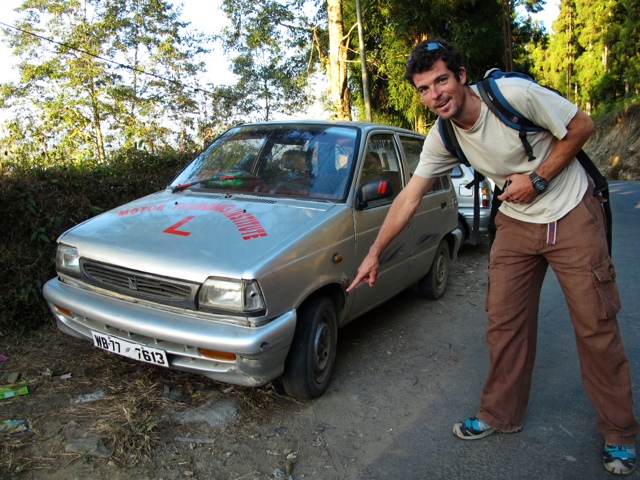
Once you reach the heady age of 16 in India you can be let loose on the road... No training, no test, just some pretty severe consequences if you do mess it up.

We have seen the occasional insulating tape red L on cars, but this is the finest example yet of any sort of formal training. You'll be delighted to see that the tyres are down to the canvas... Only in India!

A big religious face-off

Once again Giles and I found ourselves lost for words today. Having agreed that the Yumthang Valley is probably one of the most spectacular places on Earth that either of us has ever visited, we were surprised to find yet more jaw-dropping sights in South Sikkim's Namchi.

Famed for the 2 huge religious statues, each standing at over 40 meters tall, the guidebook failed to prepare us for the view from each. Wow. The Kandchenjunga range remained crystal clear all day, providing a unique backdrop to some unique monuments.

Namchi sits on a ridge, and 5 km either side are 2 big peaks. Perched on the easternmost is a giant Buddhist guru, and on the western summit, a giant Siva. These are the biggest Buddhist and Hindu dedications in the world! Having found ourselves ensconced in a Buddhist household for the past 2 months we decided to embrace Hinduism for the afternoon.

A good hike got us to the top within an hour and there, standing before us, we found what can only be described as the result of when Hinduism met Disneyland!

We were as bemused as we were impressed, and spent a very happy hour wandering in and out of temples and shrines. But of course, awe-struck as ever, the mountains behind the towering greats were what really made the day. Beautiful.


16 Nov - Where Nature Is Still In Charge

Everywhere we have been on our trip North in Sikkim is on its second, or even third or fourth, bridge. There is perhaps no more stark reminder of the fragile permission which nature gives man to inhabit this planet, and indeed the resilience of man to make it work.

Up near Zero Point the cause of the destruction is clear, as the pile of tangled metal lies hidden beneath a mass of boulders brought down by the last surge of the river. But further down the valley, in Lachung, one forlorn concrete pillar is all that remains of the original suspension bridge which provided a line of communication between the 2 sides of the valley. 6.8 on the Richter scale last September put paid to that. Our guide, Benum, smiles ironically as I ask him whether the army-constructed replacement is temporary. I'm not sure whether his hint is with reference to the likelihood of nature taking charge again, or whether it is simply that the replacement works...

We left Chungthang and the new hydro project behind to arrive at Singhik and the most extraordinary view. What the clouds had obscured on our journey up, was resplendent in the midday sunshine. It was as if nature wanted to leave us with one final reminder of her authority before we returned to the civilised comfort of Gangtok. Looking all the way up a deep valley, and beyond, we were given the best view of Kanchenjunga and her sisters yet. Bearing in mind the visual feast of the days before, and the fact that we had already done this journey the other way, the treat was enhanced by its ability to once again leave us both speechless.

The rest of the journey back to Gangtok was bumpy, long, but otherwise uneventful. Having sat down all day, Sarah and I decided to unwind (physically quite literally!) with a run along Gangtok's pretty ridgeway and up to the Enchen Monastery. I think that the sight of two Westerners in running kit racing two young monks down the main avenue to the monastery past rows of prayer wheels will not be one the older residents forget for some time. The little boys running with us in flowing red cassocks clearly thought it was wonderful though.

Returning from the monastery's hill top position to our hotel, we watched the sun set above the hills to the West of Gangtok, and more importantly, turn a deep bronze against the pristine white peaks of our omnipresent overseer. As runs go, I think that we'll do well to better it.


Friday, November 16, 2012

15 Nov - Lachung to Zero Point

Zero point. It's something you might expect to find in a modern version of a Jules Vernes story. The destination and end of an epic journey and yet perhaps the start of something monumental.

'Zero point' for us today really wasn't far off the mark. From our starting point in Lachung, deep in North Sikkimese Himalaya, what the local guides call 'zero point' was our target for the day: the end of the road north towards Tibet at a quite literally breath-taking 16000 feet. You cannot go any further due to tensions at the Tibet-India border.

To get there requires no less than 3 permits and as many check points at the various army bases positioned along the route. The trip up there is an official tourist trail, but the fact that we had to put so much effort into getting there, so few people do it, and the mystery of what might lie beyond, made this much more of an adventure.

We set off, leaving civilisation behind us, and climbed hard. Benum, our guide, hadn't disappointed in his managing of our expectations the day before; it was only what seemed like a few minutes later that Sarah and I grinned at each other, harmoniously mouthed 'amazing', and took in the simply extraordinary scenery unfolding before us. After tree lined valleys, topped by jagged peaks, we ran into the first obstacle to really challenge both driver and jeep. A massive moraine field at 13000 feet, further disturbed by last year's quake, looked from the bottom to be impregnable. But the bulldozers had done a grand job; we bumped and eased our way around the worst up a winding track which took us into a wide Alpine wilderness. From the top of the mess of boulders we were treated to a magical view of the vast valley floor and its immense walls which climbed into snow capped giants. Down the middle the oh-so-blue river rushed downhill, while ahead lay a taste of the true Goliaths awaiting us further up. It was almost visual overload.

From this point we left the valley floor to climb up a surprisingly well maintained ribbon of asphalt draped in endless hairpin loops up the mountainside towards the tundra above. Either side now, granite, snow and elegant ice falls to keep us company as the oxygen got thinner. The views ahead and behind simply became more and more superlative until on rounding the final bend, with the Tibetan plateau in sight, we reached a shabby open area where a couple of ladies, wrapped in all the clothes they owned, sat brewing tea in the open air. The punctuation of the road ending was as abrupt as the name Zero Point might suggest; beyond, a track strewn with sump destroying boulders and ice. But the views... I'm not even going to try to put them into words. Enjoy the below, but believe me, these pictures don't even start to do it justice. Almost certainly the most stunning part of the planet we have seen to date, partly because of the scenes, but an awful lot because of the remoteness and secrecy which surrounds it.

14 Nov - North Sikkim Tour Day 1 - Evidence of an Earthquake

I was just lining up the torrent of superlatives for today's journey when Benum, our guide, turned back from his seat in the front of the jeep with a knowing smile: "Tomorrow is even better. You will see better views then."

Up to that point we had spent 3 hours driving through scenery north of Gangtok which I can only really describe as movie-set perfect. Jaw -dropping waterfalls, overhangs thousands of feet tall and below, the majestic Teesta river powerfully pushing south, a mix of turquoise purity and fierce white rapids.

Without a doubt the most spectacular journey by car in our lives to date. But I'll be good and not effuse too much in the knowledge that if I do then my bag of colourful language will be empty for what promises to be even more incredible tomorrow as we head up to the Yumthang valley, the Northernmost accessible point of north-east India.

Our route took us North from Sikkim's capital, Gangtok, through to a small village called Lachung, the final staging post before Yamchung. What we hadn't counted on were the stark reminders of the devastating earthquake that ripped through the region last September. 700 or so Nepalese and Indians, most of them workers constructing the massive hydroelectric dam at Chungthang, were killed as the quake topped out at 6.8 on the Richter scale. Sikkim is proud of its well maintained road network, so the countless hours today spent bouncing along the hastily bulldozed replacement tracks gave some idea of the scale. Either side of us, huge boulders, one of which still on top of the crushed lorry unfortunate enough to be in the wrong place at the time, and ugly scars where the land had dropped away. Several times we were held up as diggers piled rubble into trucks to be removed. When the quake struck, the village we are now at and further north were cut off for a month and a half.

As ever, the bridges, of which in landscape like this there are many, provided a source of concern and intrigue. At one point we spied the next precarious crossing of the Teesta in a deep forested valley. There was no doubt at all that it had long since ceased to be sound, and so it was a relief to find another paralleling it across. In fact there was a further more derelict one next to it, and yet another under construction. The engineering effort to span these huge valleys is immense, not to mention the infrastructure required to get the equipment and materials there in the first place.

But massive engineering challenges are not something that India is shy of. As we approached Chungthang, below is the simply vast project to turn the Teesta into the main power source for Sikkim. An entire temporary town, massive dam, and perhaps most impressive of all, a gaping tunnel into the eastern wall of the valley into which the entire river is now diverted to allow construction. It's a biblical achievement.

So, quite a day. The power is off, it's really cold, and we are exhausted from a entire day of intense visual treats. Who knows how we are going to feel after tomorrow?

Pictures:

Waterfalls, bridges and overhangs while the bulldozer continues to clear up the mess.